Anton Opic

AOProTec

AOProTec
Security

AOProTec

IN DEVELOPMENT

Security software for Windows. Real-time protection, memory and file scanning, behavioural monitoring, and a kernel-mode driver. Built to report honestly about what it can and cannot see.

Not available to buy yet.

πŸ”” Notify me when it's available

Pictures and videos

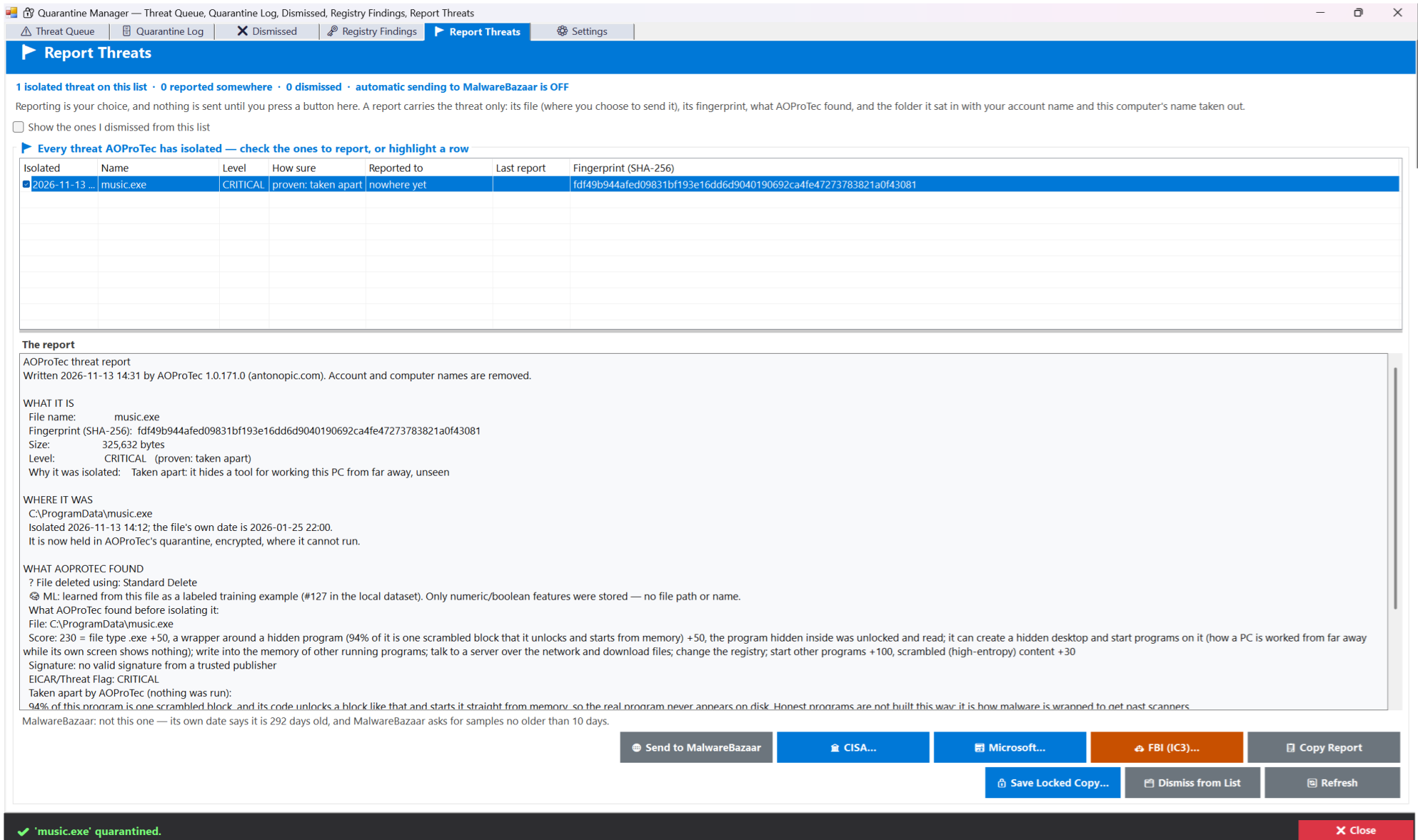
Report Threats in Quarantine manager
Added 23 Nov 2026

Report Threats

Report Threats in Quarantine manager

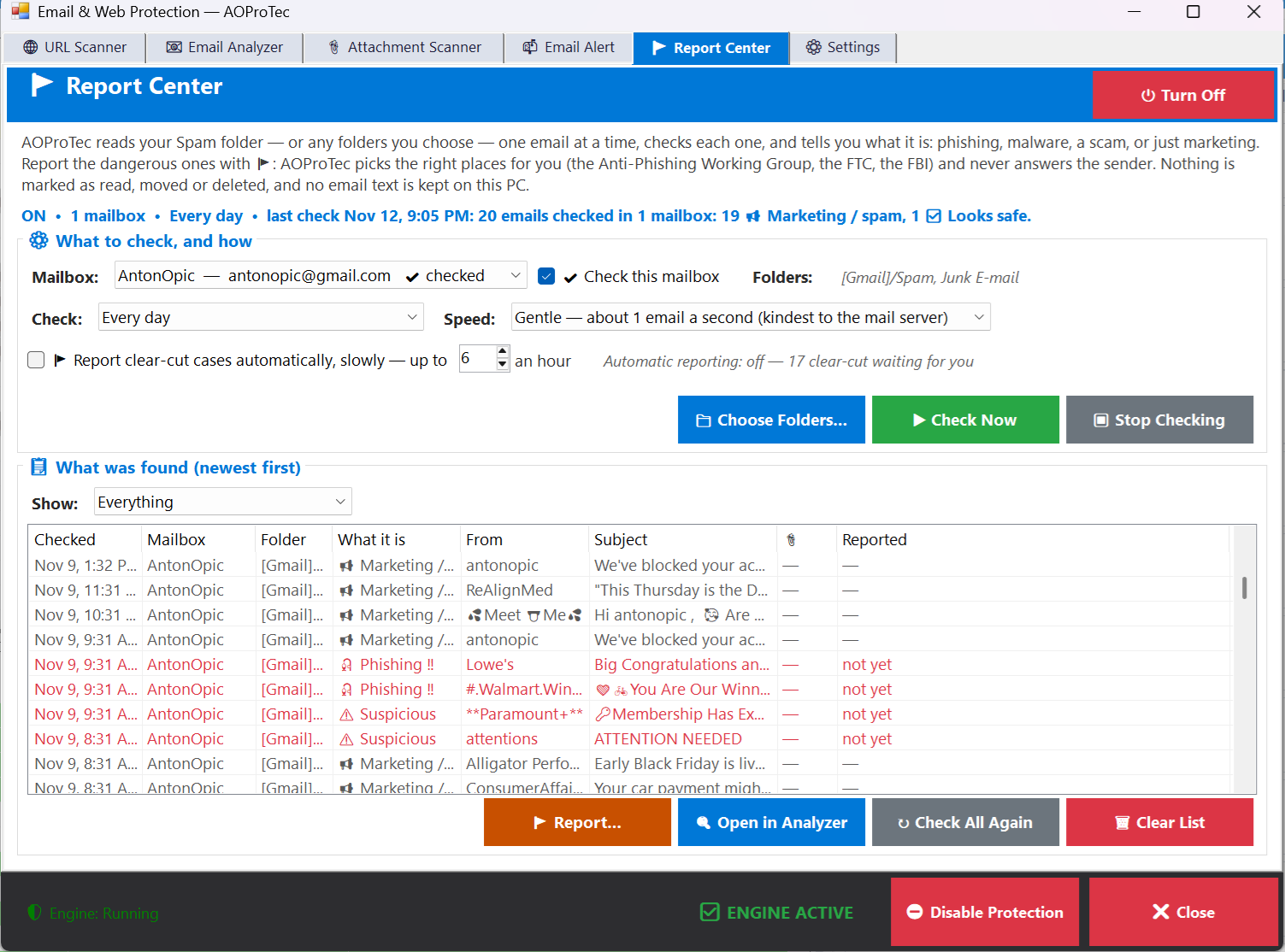
AOProTec Email & Web Protection - Report Center
Added 23 Nov 2026

AOProTec Email & Web Protection

AOProTec Email & Web Protection - Report Center

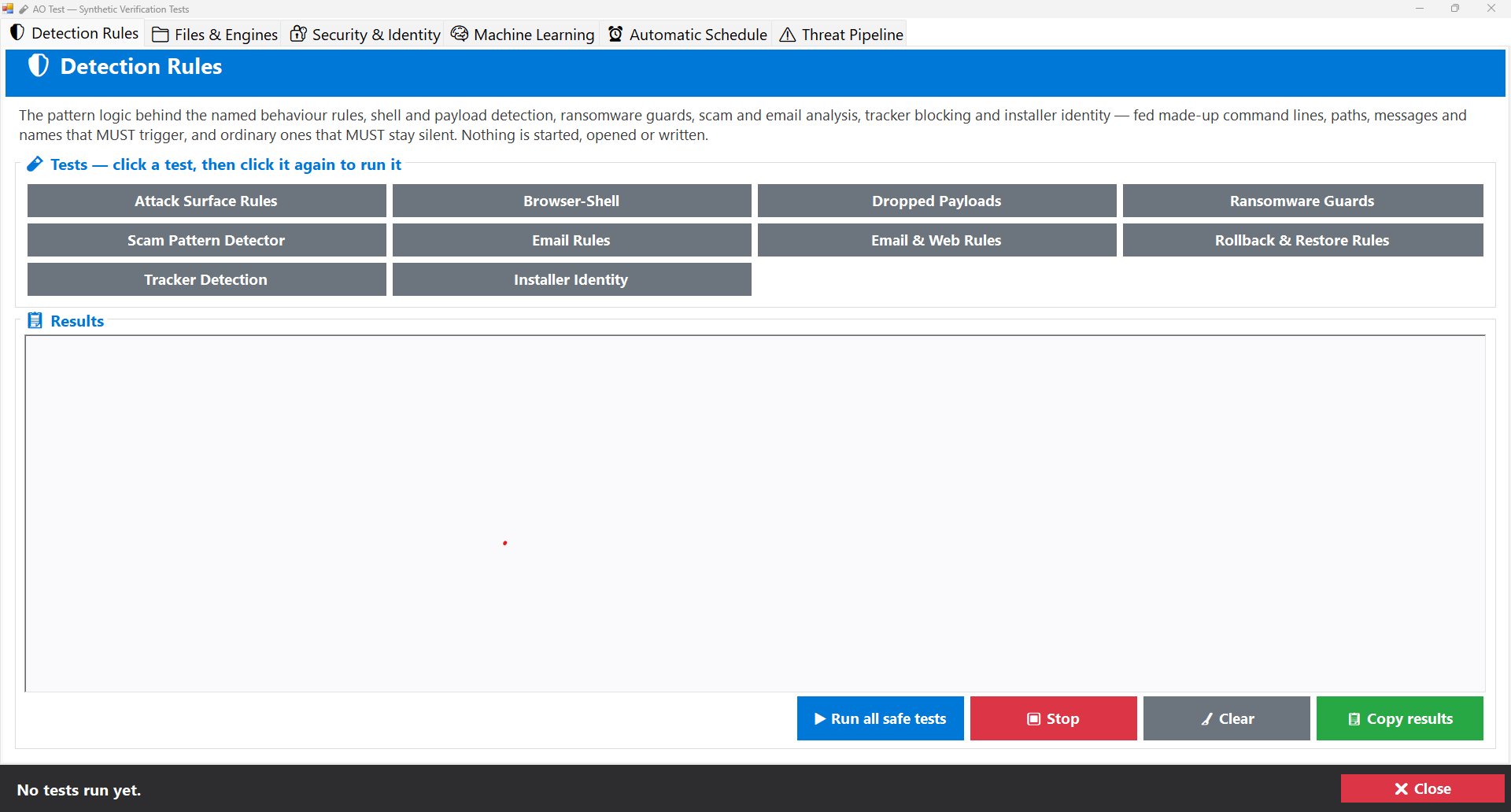
Detection Rules
Added 23 Nov 2026

AOTests Detection Rules

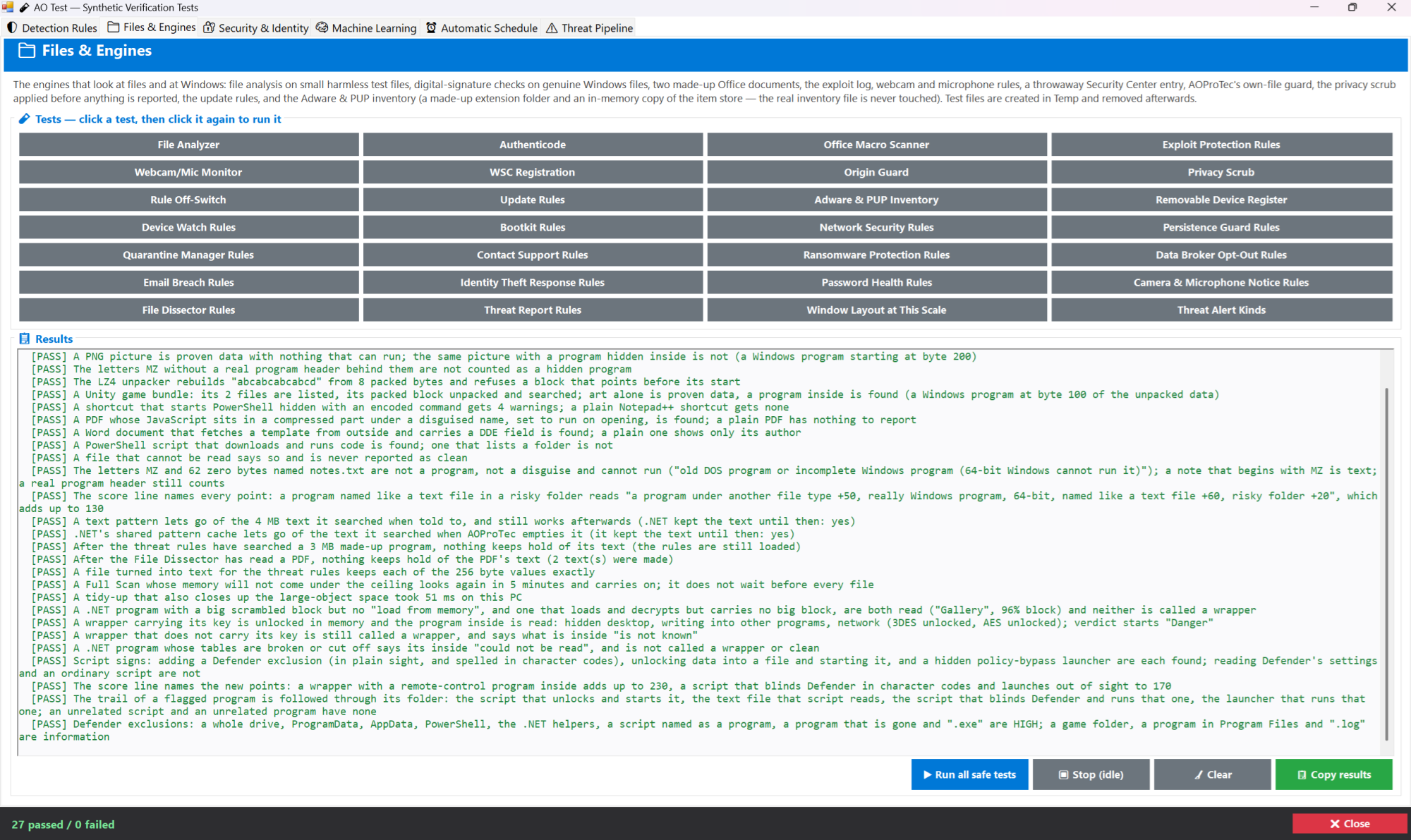
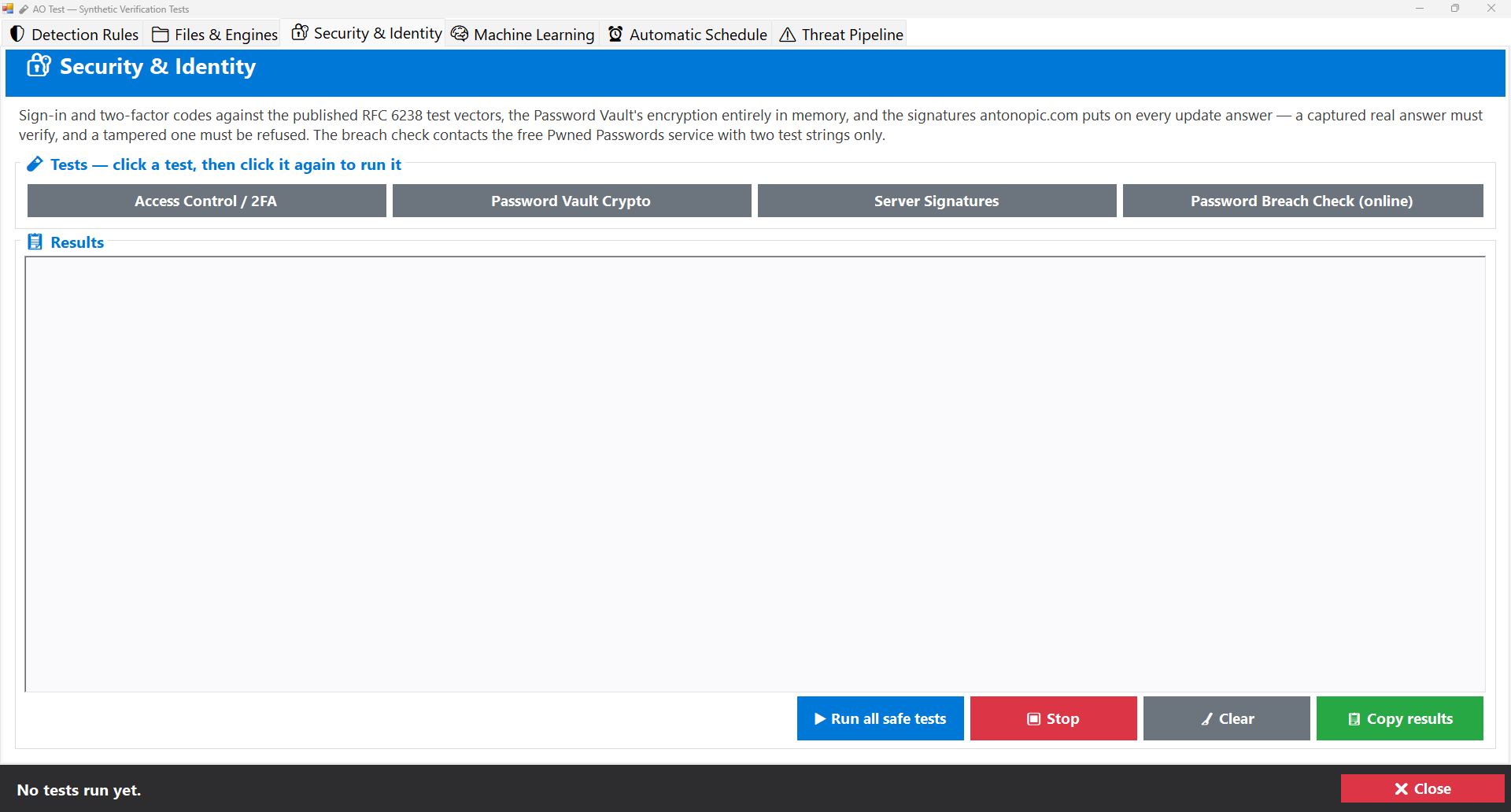
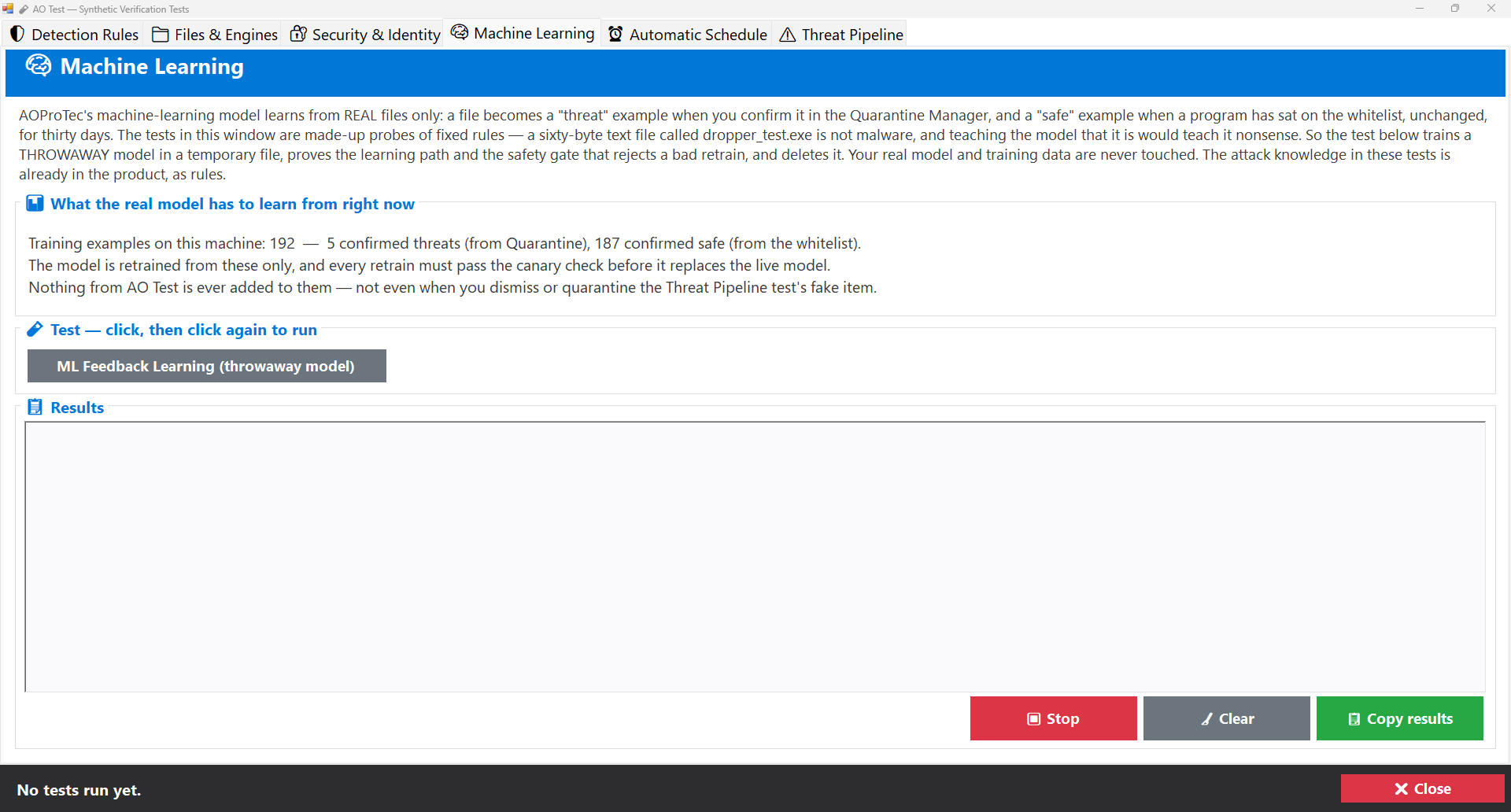
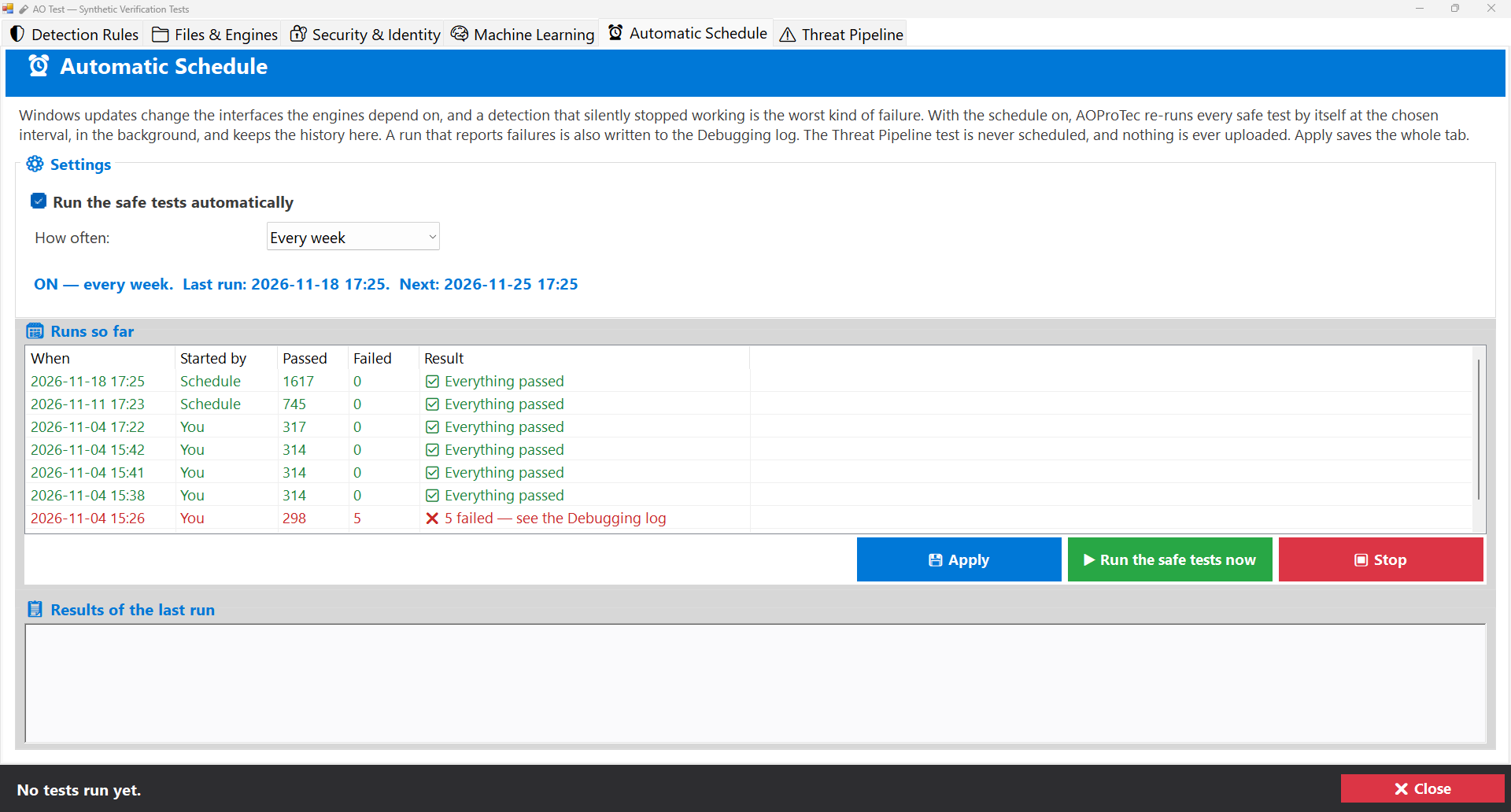
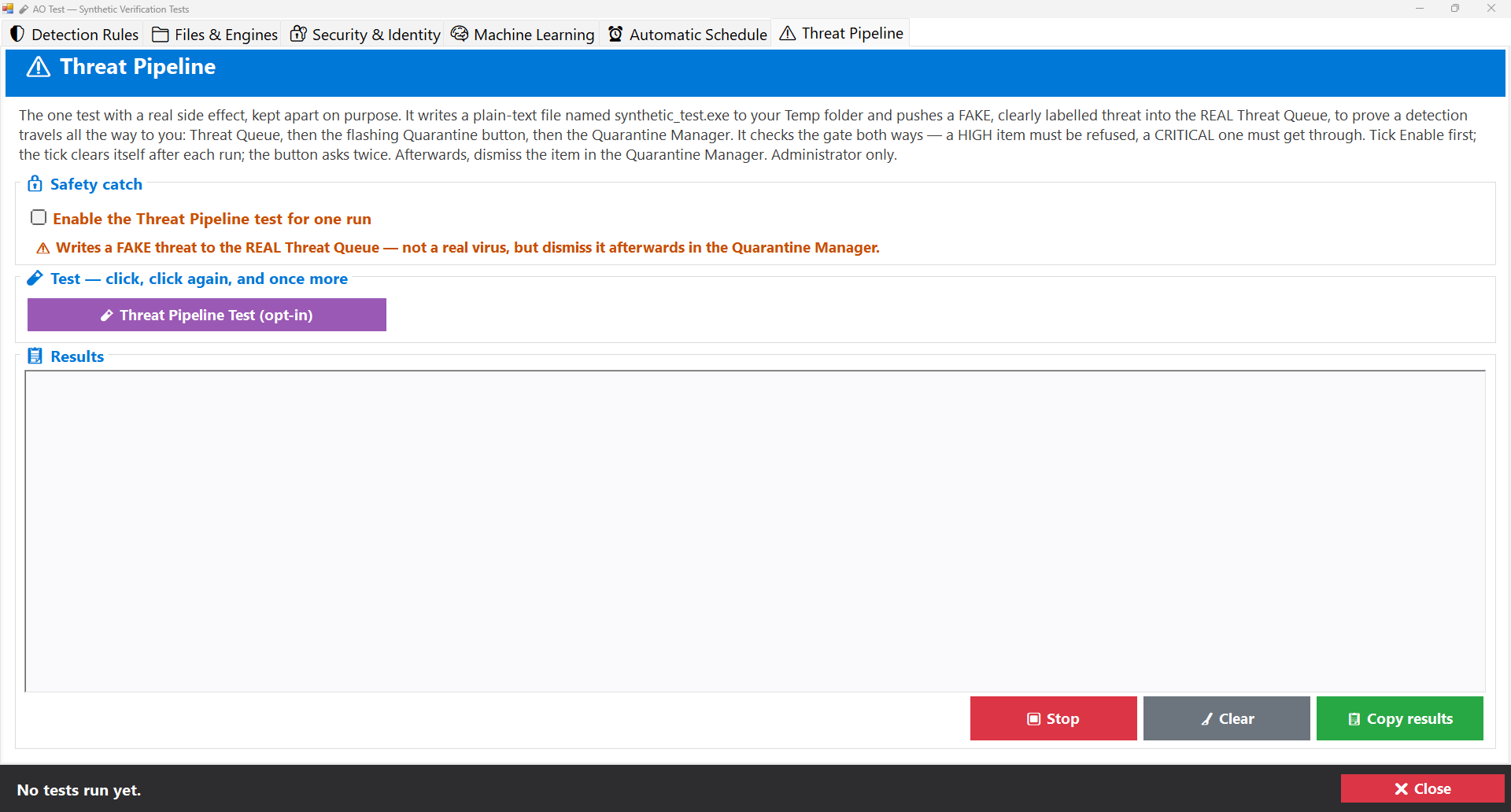
πŸ›‘ Detection Rules β€” the pattern logic itself: the eleven named behaviour rules, browser-started shells, payloads run out of Temp by Java or Windows Script Host, ransomware guards (decoys, raw-disk writes, backup and shadow-copy destruction, even inside an encoded PowerShell command), scam text, email rules and look-alike links, tracker blocking, installer identity. πŸ“ Files & Engines β€” file analysis, digital signatures, Office macros, the exploit log, webcam/microphone rules, Security Center, AOProTec's own-file guard, the privacy scrub, update rules. πŸ” Security & Identity β€” sign-in and two-factor against the published RFC test vectors, vault cryptography in memory, and the server's signatures: a real signed answer from antonopic.com must verify, and the same answer with one digit changed must be refused. 🧠 Machine Learning β€” the learning path on a THROWAWAY model, and a live count of what the real model learns from (see below). ⏰ Automatic Schedule β€” the safe tests re-run by themselves every day, three days, week or two weeks, with the history kept. ⚠ Threat Pipeline β€” the one opt-in test with a real side effect.

Files & Engines
Added 23 Nov 2026

AOTests Files & Engines

AOTests Files & Engines

Security Identity
Added 23 Nov 2026

AOTests Security Identity

AOTests Security Identity

Machine Learning
Added 23 Nov 2026

AOTests Machine Learning

AOTests Machine Learning

Automatic
Added 23 Nov 2026

AOTests Automatic

AOTests Automatic

Threat Pipeline
Added 23 Nov 2026

AOTests Threat Pipeline

AOTests Threat Pipeline

Help Documentation Debug
Added 23 Nov 2026

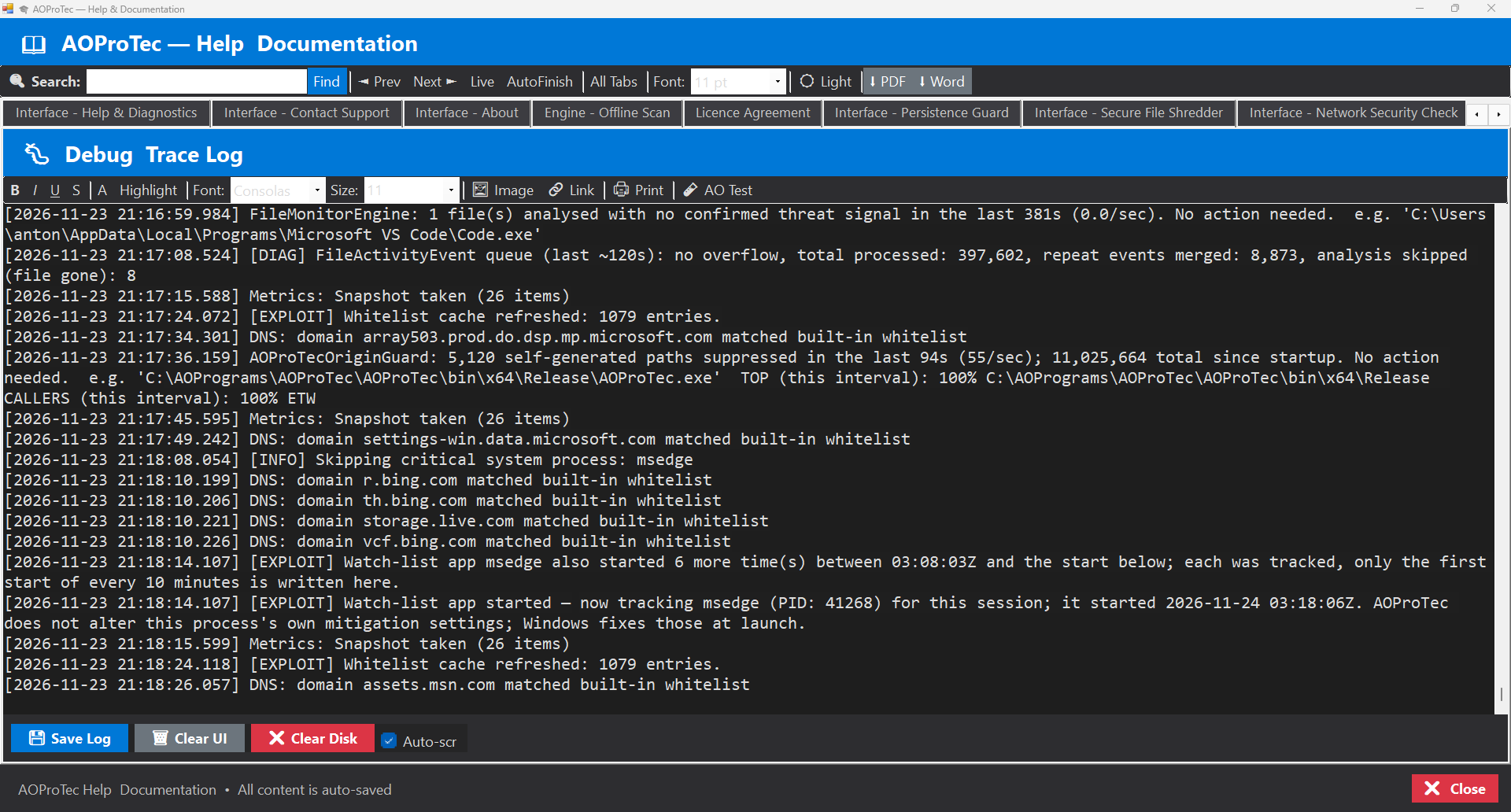
AOProTec Help Documentation Debug

Help & Diagnostics (this window) β€” Interface Guide
═══════════════════════════════════════════════════════════════

🎯 WHAT THIS WINDOW IS FOR
-------
The complete manual for AOProTec β€” what it does, how it works, and how to use it β€” plus the live diagnostic view of the running application. It is both the documentation and the instrument panel.

πŸ“š HOW THE TABS ARE ORGANISED
-------
Overview start here. Network Isolation & placed early on purpose: it is the tab you Recovery need in an emergency, and scrolling for it while a machine is compromised is no time to be searching. Interface - … one per window: what it is for, every control on it, and how to use them. Engine - … one per engine: what it does underneath. My Notes, Errors, Debug your notes and the live diagnostic tabs.

Each protection area generally has BOTH an Interface tab and an Engine tab β€” one for the window you look at, one for the machinery behind it.

πŸ“ MY NOTES TAB
-------
A free-text scratchpad that saves automatically and survives restarts. βž• Add Note has 🎀 Speak: Windows voice typing (Windows key + H) in the note box. Windows sends the voice to Microsoft's online speech service to make the text, so it needs internet and Online speech recognition turned on (Settings β–Έ Privacy & security β–Έ Speech). πŸ’Ύ Save writes your notes as a table (Done, Date, Note) in the format you pick β€” Text, PDF, HTML, Excel, Word, CSV, Rich Text, JSON, XML, LibreOffice and more. Errors and Debug save the same way (Time, Message).

❗ ERRORS TAB
-------
Genuine failures only. This tab staying empty is meaningful β€” it is the fastest way to tell whether AOProTec itself is healthy. Routine conditions are deliberately kept out of it so that anything appearing here is worth reading.

🐞 DEBUG TAB
-------
The live activity stream: what the engines are doing, moment to moment. Useful when you want to confirm something is actually happening rather than assume it.

It is a VIEW, not the record. Under heavy activity the display skips ahead to keep up and says so β€” nothing is lost from the log file on disk, only from what is drawn on screen. Detection never depends on this window being open.

While this window is hidden in the tray it takes no work at all. When you open it, it shows "⏳ Loading…" and then the newest 1,000 lines from the log files at once β€” no catching up β€” and carries on live from there.

The toolbar carries Print and πŸ§ͺ AO Test, which runs the synthetic verification suite β€” see the AO Test tab.

πŸ’Ύ WHERE THIS CONTENT LIVES
-------
Tabs are written to %APPDATA%\AOProTec\Help. Copying tabs.xml to another machine carries every tab with it, including any written by hand. The .rtf files beside it are regenerated on each launch, so they do not need copying.

Content maintained in code takes precedence over the stored copy, so updated documentation always reaches the screen rather than being blocked by an older saved version.

Help Documentation Max Parallel Scan Threads
Added 23 Nov 2026

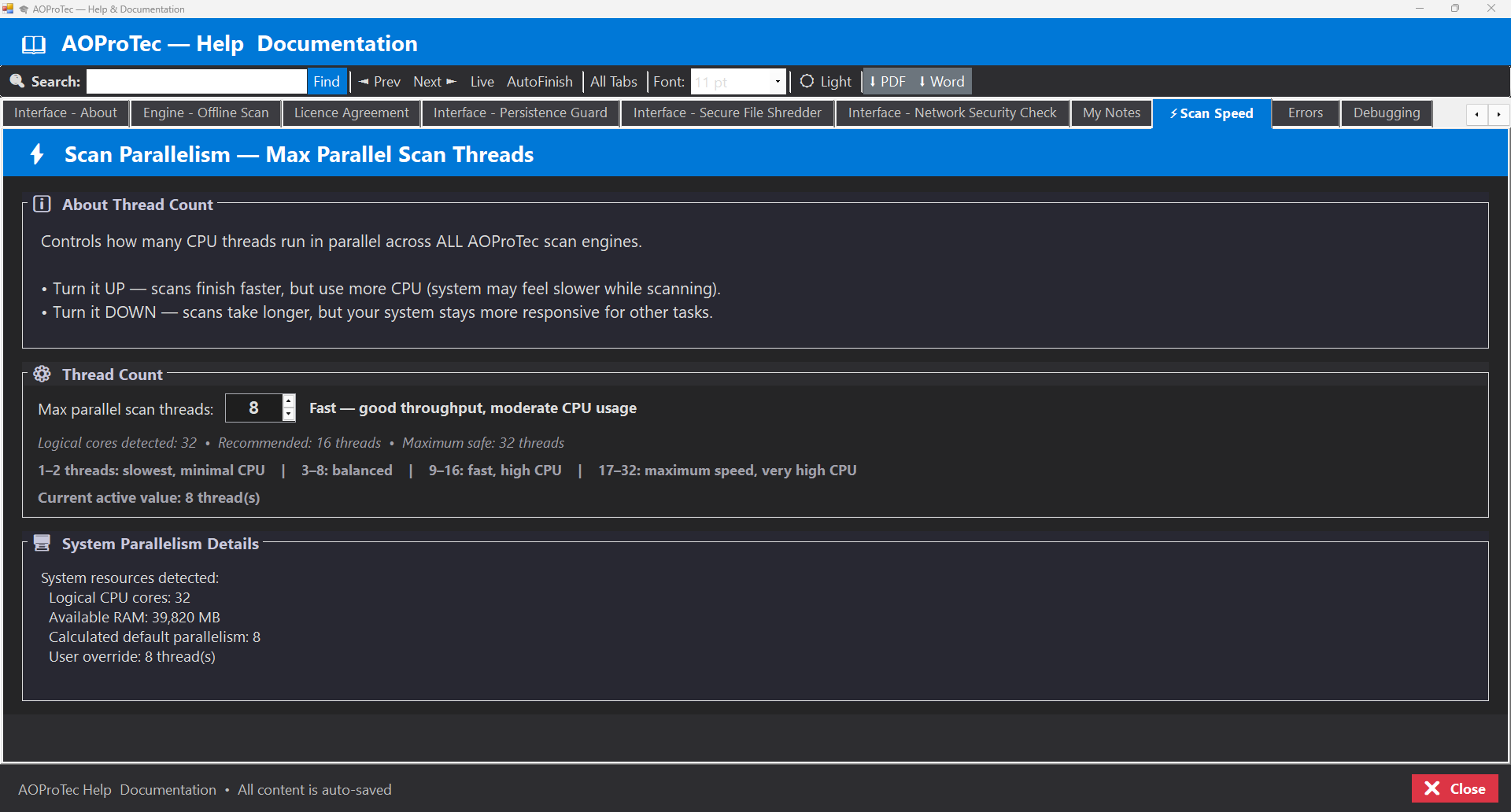
AOProTec Help Documentation Max Parallel Scan Threads

Help Documentation Max Parallel Scan Threads

Development updates

17 November 2026

Nothing to remember: AOProTec now learns what is normal on a PC by itself.

AOProTec keeps a record of what is normal on a PC, so that only changes are reported. In 1.0.188 that record sets itself after a learning week, and reputation handles the routine changes afterwards.

Read the whole updateClose this update

Five of AOProTec's guards compare a PC with its own record of what is normal: the listening ports, the displays, the audio devices, the browsers and everything set to start by itself. Until now a button set those records, and I kept asking myself when to press it. So I looked at what the big security products do. Microsoft's own tools learn for a set time, from a few days to a few weeks, and then decide; others learn for up to two weeks and ask for one review at the end; others again trust by reputation. None asks a person to press a button again and again.

In AOProTec 1.0.188 a guard with no record learns for 7 days of AOProTec running. Then AOProTec records it itself, but only when no row is waiting in the Threat Queue and no threat was confirmed that week; a confirmed threat starts the week again. One short notice says what was recorded.

After that, reputation does the routine work. A new startup entry, scheduled task or service, or a new port that only the PC itself can reach, is taken as normal by itself when its program is validly signed, sits in a protected folder, shows no risk, and is not a script host or a remote-control program. On my laptop I created two test tasks: the one that starts a Windows program signed by Microsoft was taken as normal by itself; the one that starts the command prompt stayed new, for me to decide. The Baselines tab shows where each record stands.

The same build brings the camera and microphone history back on the newest Windows. On my main PC, Windows moved its own record of camera use into a database on 22 September, and its camera service keeps that database to itself. AOProTec now reads two other sources Windows keeps: its camera log, which this morning named my recording program and my browser when they opened the camera, and its audio system, which named my recording program while it recorded from the microphone.

And a small one: my all-in-one printer was listed as a phone or camera, because the part Windows lists without a drive is its scanner. It is now listed as a printer.

On my laptop, AOProTec's own tests ran inside the real program: 1,531 passed, 0 failed.

17 November 2026

Every disk, every boot file, and what really ran at the last start.

A bootkit starts before Windows does, so it starts before every antivirus too. In AOProTec 1.0.186, Bootkit Detection checks the whole path my PCs take to start, and it reads Windows' own TPM-backed record of what really ran.

Read the whole updateClose this update

When a PC starts, the firmware runs a boot program, the boot program starts Windows, and only then does any security software wake up. A bootkit hides in that first stretch: in a disk's first sectors on an older PC, on the boot partition on a newer one, or in the settings that tell Windows how to start.

AOProTec now asks Windows which disk it starts from and reads every disk. On both my PCs Windows starts from disk 1, with the data on disk 0, and each row in the window says which is which. On a GPT disk the partition table is kept twice, at the start and at the end, each with a checksum; AOProTec checks both copies the way the UEFI specification describes. On my main PC both disks pass, and the megabyte of hidden sectors in front of the first partition holds nothing but zeros.

The new Boot Files tab lists every file on the boot partition: 156 on my main PC, 145 on my laptop. Every boot program gets Windows' own signature check, and AOProTec compares it byte for byte with Windows' own copies in C:\Windows\Boot. On both PCs all five boot programs are validly signed and are exactly Windows' own. The signs Microsoft's incident responders published for the BlackLotus bootkit are checked on every scan.

The new Secure Boot tab follows Microsoft's 2023 certificate move. The 2011 certificates expired this year, the last on 19 October. My main PC has the new ones in place: Windows reports Updated, and the firmware's list holds Windows UEFI CA 2023. My laptop has Secure Boot switched off on purpose for driver testing, and the tab says plainly that it has not made the move yet.

The new Last Start-up tab reads the Measured Boot log Windows keeps with the TPM. On my main PC the firmware's fingerprint of Windows Boot Manager at the last start matches the file on the disk exactly. My laptop's firmware writes the older format of the same log, and AOProTec reads both: the match holds there too.

The new Boot Settings tab shows what Windows will do at the next start (test signing, the driver signature check, debuggers, the early-launch driver policy and more) beside what Windows is doing now, read the same way on every language of Windows.

Every boot finding goes to the Threat Queue by itself. AOProTec never rewrites a boot record or moves a boot file, because one wrong write can stop a PC from starting; the finding comes with the steps for that PC, Dismiss tells AOProTec a change was mine, and when the piece is back to normal AOProTec closes the row by itself. AOProTec's protection service also checks the boot chain within minutes of every Windows start, before anyone signs in.

On my laptop, AOProTec's own tests ran inside the real program: 1,496 passed, 0 failed. After its first look, a whole boot check takes under two seconds there.

16 November 2026

The four doors a loader left behind.

Taking a threat's files away is only half the job. On my PC, AOProTec's Persistence Guard showed four scheduled tasks in red: doors a loader had left open to start itself again. On 16 November all four were closed, one press each.

Read the whole updateClose this update

A program that sneaks onto a PC wants to stay there. The usual way is a scheduled task: an instruction to Windows to start a program again and again, every few minutes, without asking anyone. Take the program away, and the instruction is still there.

Persistence Guard reads fifteen kinds of place where Windows can be told to start a program by itself, among them startup entries, scheduled tasks and services. On my PC that is about 500 entries, read in under a second. Four of them it showed in red, as high risk, and it said why in plain words.

Each of the four started a program that was no longer there, from a folder any program can write to. In AOProTec's words: the entry still fires, and it would run anything put back at that path. Each repeated itself every 4 minutes 42 seconds to every 9 minutes, which AOProTec calls the rhythm of a loader keeping itself alive, not of an updater. And three of the four ran with the highest rights the account has.

Their names were Date, AsyncState, TargetSite and Data: ordinary words from Microsoft's own programming library, the kind of name nobody looks at twice. AOProTec does not judge an entry by its name. It judged these four by what they do.

Windows' own records show where they came from. The first was made on 25 October 2025, about a minute after a scrambled payload file appeared in the Public folder, and the second four days later. The third was made on 25 January 2026, three seconds after music.exe, the remote-control program AOProTec took apart on 13 November; the script that installed music.exe had told Windows Defender to ignore the very program this task starts. The fourth followed the next day. Windows Defender's list of things to ignore named three of the four programs. One intruder, two visits.

On 16 November, just before five in the afternoon, I opened Persistence Guard, chose each red row and pressed Remove Entry. Four presses, eleven seconds. Before each task was deleted, AOProTec wrote down what it ran on the History tab, so the record stays. After every press Persistence Guard looked again by itself: three in red, then two, then one, then none. The scrambled payload file from October went into quarantine the same afternoon, by my own hand, with Manual Quarantine.

A task like this does nothing while its program is missing, which is exactly why it is easy to overlook. But it keeps firing, and the moment anything puts a program back at that path, Windows starts it. Closing the door matters as much as taking the program away.

Next, AOProTec will bring entries like these to the Threat Queue itself, beside the rest of the threat's family, so nobody has to go looking for them. The decision to remove one will stay yours.

16 November 2026

How AOProTec is going deeper into every file

We studied how the largest antivirus makers describe the way they judge a file, compared it with what AOProTec already does, and set out five steps to take AOProTec's dissection of a file further, without adding false alarms.

Read the whole updateClose this update

AOProTec judges a file by taking it apart and reading what it really is, never by its name alone. On 16 November I asked for a plan to take that as far as it can go.

Before any code was written, we read what the makers of the best-known antivirus products publish about how they judge a file, starting with Microsoft's own documentation. Microsoft describes Defender as many engines working together: fast models on the PC, behaviour monitoring, memory scanning, an emulator that unpacks malware, and a cloud sandbox where suspicious files are run and watched. Norton's Insight rates files by their reputation. ESET describes a memory scanner that catches malware once it reveals itself, Kaspersky an emulator for programs and scripts, and Sophos a picture of where an attack started and which files it touched.

AOProTec already opens the common archive formats and judges every file inside them, reads what a script says it does in its own words, takes .NET programs apart and reads the program hidden inside a wrapper without ever running it, and ties together the files that belong to one threat so they can be quarantined together.

The plan takes this further in five phases, each its own update:

Phase A, in AOProTec 1.0.184: whatever AOProTec unwraps is judged again, exactly like a file on the disk. Encoded text is decoded and named for what it really is. Check a File includes the Full Scan's own judgement.

Phase B: scripts peeled layer by layer, so a command hidden in code or character tricks is read in plain words.

Phase C: the whole story of a threat. The startup entries, scheduled tasks and other traces that point at it come with it into the Threat Queue, and leave together through the Quarantine Manager.

Phase D: native Windows programs opened, to show in plain words what they are built to do.

Phase E: more containers opened, among them OneNote files, web pages that carry a hidden file, installer packages and 7z archives.

Going deeper must never mean more false alarms, so every phase follows the same rules. Nothing is ever run to find out what it is. Every new check is first counted against the honest files on two real computers, and only a sign that no honest file carries is allowed to raise an alarm. A file AOProTec could not read is never reported as clean. And every update is tested on a separate test laptop before I sign it.

16 November 2026

Any file, into quarantine, by your own hand.

AOProTec 1.0.183 lets you choose any file on your computer, check it with nine of AOProTec's checks, and put it in quarantine yourself. And when it catches a launcher script, the payload that script names comes with it.

Read the whole updateClose this update

Quarantine Manager has always had a Manual Quarantine button, for the moment you know better than the engines. Until now it listed the programs that are running. But a threat is often more than a running program: a script that starts it, a scrambled data file it is unlocked from, an archive it came in. Those pieces are never in the list of running programs.

From 1.0.183, Manual Quarantine has a second tab, Files on Disk. Choose any file, with Browse or by pasting its path. Before you decide anything, AOProTec shows you what can be read without running it: its size, its dates, what it really is (a program, an archive or a PDF is recognised by its first bytes, whatever its name claims), and its fingerprint.

Check This File runs nine of AOProTec's checks on that one file and shows the answers side by side: the AOProTec threat list, the antivirus Windows uses, AOProTec's own rules and its own model, the digital signature, where the file came from, what the file really is, and Office macros. When a check finds something, the file goes to the Threat Queue, where AOProTec examines it further.

Quarantine File is your own decision. You choose a threat level, and the file goes into the same encrypted vault as everything else AOProTec quarantines, through the same quarantine step a running program goes through. It is recorded on the Quarantine Log, and you can restore it from there any time. AOProTec refuses its own program files and its own records here, so nobody can switch the protection off by accident.

The family of a threat also grows by one more tie in this version. When the file AOProTec reports is a launcher script, the encoded payload that script names in its own folder now gets its own row right beside it, so launcher and payload go into quarantine together.

Check a File used to live in Cloud Threat Intelligence. It now sits in Quarantine Manager, beside the quarantine itself, where a decision about a file is made. Cloud Threat Intelligence keeps the history of every file checked.

Next, I am taking AOProTec's dissection deeper still: more ways to find every file that belongs to a threat, and to be certain about each one before it is ever called a threat.

16 November 2026

The night AOProTec finished the job.

On 13 November AOProTec took apart a remote-control program hidden on my own PC. At two in the morning on 16 November, its nightly scan found the rest of that program's family, and by 4:39 that morning every piece it found was in quarantine.

Read the whole updateClose this update

A program like music.exe rarely travels alone. It arrives as a family: an archive it came in, a script that starts it, a block of scrambled text it is unlocked from. Take out one piece and the others are still lying there.

On 13 November AOProTec took music.exe itself apart, layer by layer, in under a second. At 2:00 in the morning on 16 November the nightly Full Scan went through my whole disk and came to the folder it had come from.

There it found the archive, winrar_33952078.zip. AOProTec opened it, in memory, without unpacking anything to disk, and read the scripts inside: scripts that tell Windows Defender to look away, and that spell out what they hide. The antivirus Windows uses agreed about both. The archive scored CRITICAL 330.

In the same second AOProTec looked at what was lying next to it. music.txt and music.vbs were byte-for-byte the same files as two inside the archive. AOProTec tied them to it and raised them with it, each with its own row in the Threat Queue, each saying exactly what ties it to the archive.

Between 4:31 and 4:39 that morning I opened the Threat Queue and pressed Quarantine three times. Each file was encrypted into AOProTec's vault and removed from the folder, and each fingerprint was reported to the AOProTec community list for review. AOProTec sent the confirmation out by text and by email; it sends at most one confirmation every five minutes, so three quick presses do not become three messages. Nothing was run to find any of this out. Together with music.exe, those three files are now in AOProTec's quarantine on my PC.

That is the kind of work I want AOProTec to do: not stop at the one file that looks wrong, but find everything that came with it.

15 November 2026

AOProTec keeps itself current, even when nobody is signed in.

A computer that is switched on but that nobody is signed in to used to wait for its updates. With AOProTec 1.0.182 it does not have to. And every version now arrives with its own notes.

Read the whole updateClose this update

Think of the computer in the corner of the office, or the family PC that stays on all week. Nobody is signed in to it. It is still on the network, and it still needs the newest protection.

AOProTec has always had two parts. One is the window you see when you are signed in. The other is its protection service, which works in the background from the moment Windows starts, also when nobody is signed in at all. Until now, only the window looked for a new version. Version 1.0.182 teaches the service to do it too. While somebody is signed in, the window keeps the schedule as before. While nobody is, the service takes over: it asks my server, makes the update prove itself through the same five checks, and installs it. The next time you sign in, AOProTec tells you it was updated, and the History tab shows that install as "automatic, nobody signed in".

Installing by itself is still your choice. AOProTec installs nothing on your computer that you did not ask for, so on a new install that box is off, and a new version waits for you to press Install. I recommend you switch it on, and the Settings tab now says why: a new version brings the newest protection and repairs, and a security program that waits for a click can stay behind for days. Under that box there is one more choice: at any time, also when nobody is signed in, or only while someone is signed in.

Every version now comes with its own notes, written when I sign it. AOProTec keeps them on your computer, under What's New, so you can read what a version brought at any time, also without the internet.

Two more things. The fingerprints of known threats and the detection rules also come from my server, and they are checked the same way before they are used. If an answer or a file for them ever fails its checks, AOProTec refuses it, keeps using what it had, and reports it to you as a finding, exactly like a refused program update. And AOProTec can tell a real forged answer from a page that is merely in the way, like the sign-in page of a hotel network, which is no attack at all.

Before I sign a version it has to pass on my test laptop. This one passed 1,447 checks there, 60 of them written for Automatic Updates alone.

Every window is getting this treatment, one at a time.

15 November 2026

Every AOProTec update now shows its proof.

An update is the one thing that replaces your security program with a new one. AOProTec 1.0.181 makes every update prove itself five times, keeps the record where you can read it, and treats an update that fails as an attack.

Read the whole updateClose this update

Think about what an update is. It is a file from the internet that replaces the program guarding your computer. If someone could slip their own file into that moment, they would not need to get past your security program. They would be your security program.

So Automatic Updates is the first window on the Detection tab to go through my routine: read every line, measure it on two real computers, read how the big companies do it, then build and test before I sign.

AOProTec asks my server for a new version by itself, every few hours. That is now the work of the update engine itself, on its own clock, whether any window is open or not. When there is a new version, it has to pass five checks before its installer is allowed to run. The answer from the server must carry the server's signature, made with a key that never leaves the server. The offer must name the exact fingerprint of the installer. The file that arrives must have that fingerprint. Windows must confirm the installer was signed by me, the same publisher as the copy you are running. And the copy that is about to run is fingerprinted once more while it is locked, so nothing can be swapped in at the last second. One failed check and nothing runs.

The window now shows all of it, in five tabs.

Overview has one box for each thing AOProTec keeps current: the program itself, the list of known threats, and the detection rules. Each box says what the last check found and when the next one comes.

History is a list of every check and every install, with the date, the versions, whether it ran by itself or because you pressed a button, and how long AOProTec was away. On my computers that is about fourteen seconds. Every install is kept. Choose one and you can read its fingerprint and how each of the five checks went.

What's New keeps the notes that come with each version, on your computer, so you can read what a version brought at any time, also without the internet. The first time you open the window after an update, that is the tab it opens on.

How an Update Is Proven lists the five checks in plain words, and under each one, the result from your last install.

Settings has three switches: check for a new version by itself, install it by itself, and keep the threat list and the detection rules current.

And if an update ever fails a check, AOProTec does more than refuse it. A failed check means something answered in my server's place, or touched the update on your computer. That is an attack on AOProTec, so it goes where every attack goes: it is written down in Tamper Protection, and it is handed to the Threat Queue in Quarantine Manager, together with the file that was refused, set aside so it can be examined. You decide about it there, like any other finding.

Before I sign a version it has to pass on my test laptop. This one passed 1,436 checks there, 49 of them written for this window alone. The laptop is also where the new update engine started on its own clock and made its first check by itself, a few minutes after starting, exactly as planned.

Every window is getting this treatment, one at a time.

15 November 2026

The Detection tab, window by window.

The Protection tab is done. AOProTec 1.0.180 takes the same routine to the Detection tab, the windows that look at what is already on the computer, and ties every one of them to the one place where a threat is decided.

Read the whole updateClose this update

An antivirus is not a set of separate tools. It is one program, and every part of it has to hand what it finds to the same place. In AOProTec that place is the Threat Queue in Quarantine Manager: a finding goes there, the file is examined there, and the decision is made there. Version 1.0.180 carries that through the Detection tab.

Persistence Guard is the window that lists everything set to run by itself on the computer. A handful of places in Windows do more than start a program: they take over sign-in, start-up, or the launch of another program. AOProTec now reads those places every minute. Reading them takes five thousandths of a second. When a new entry appears there, a full sweep starts at once, and the entry goes to the Threat Queue: with the program it names when it names one of its own, and in plain words when it names only a part of Windows. A new entry in Windows Defender's list of things it is told not to look at is treated the same way, because telling the other guard to look away is the first step of many attacks.

I tried it on my test laptop with a made-up, harmless entry. It was found 55 seconds after I placed it. The sweep took a second and a half, the entry was in the Threat Queue straight after, and five seconds later the laptop told me about it. Then the entry was taken away again.

The History tab of Persistence Guard keeps its room for real changes. Windows switches some of its own services between automatic and manual many times a day. Such a service is still installed, so it is no longer written down as gone and back again.

The Memory Scanner looks inside running programs. When you start a scan yourself and it finds something serious, the Threat Queue now gets one row for that program, with the program's own file, so the file can be examined. That is the same hand-over the nightly memory scan uses, and it works whether the window is open or not.

Machine Learning has a tab where you can ask the trained model about a file. When the model rates a file as malware, the file now goes to the Threat Queue as suspected, not confirmed. A model's rating is a likelihood learned from examples, so the file is examined like any other, and your answer in the queue is what the model learns from.

The Secure File Shredder destroys files for good, so it now knows what it must never take: a file that belongs to AOProTec, including anything in quarantine, one of AOProTec's own program files, and anything in the Windows folder. Each refused file says why on its own line. It also tells you the kind of drive each file is on, drive by drive.

Tamper Protection, which arrived in the last version, ties a change in AOProTec's own settings to a program by the moment that program opened the file. That is the one report from Windows that carries the file's name itself. On the test laptop a made-up program added a line to a made-up list file and was named two seconds later. It deleted a second one and was named again.

One setting now lives where scans are set up. The number of threads every scan shares is set in Scheduled Full Scans and on the Scan Parallelism tab of Help. The other windows show their own settings only. Three windows that kept redrawing their figures in the background now do it only while they are on the screen, and at once when you open them.

Before I sign a version it has to pass on my test laptop. This one passed 1,385 checks there, 66 of them new.

Every window is getting this treatment, one at a time.

15 November 2026

AOProTec now names the program that touches AOProTec.

The first thing an attack goes after is the security program itself. AOProTec 1.0.179 watches its own files, its own settings and its own service, and when something touches them it tells you which program did it.

Read the whole updateClose this update

A burglar who has the time deals with the alarm first. Malware does the same: before the real attack, it tries to switch the security program off, change its settings, or put something of its own in its place. If that works, everything after it happens in silence.

Version 1.0.179 of AOProTec is built around that. Tamper Protection is the ninth window to go through my routine: read every line, measure it on two real computers, then build and test before I sign. It is also the last window on the Protection tab.

It starts with AOProTec's own program files. Each one has a fingerprint, a long number that changes if even one byte of the file changes. AOProTec records those fingerprints once for the version you have installed and keeps the record. Every time AOProTec starts, it compares its files with that record, so a file that was changed, removed or added while AOProTec was not running is found the moment it starts again. While it runs, the files are checked again every few minutes, and at once when one of them changes. After an update the files are fingerprinted again for the new version, and a notice says so.

Then there are AOProTec's settings and lists: what you approved, what you dismissed, what is waiting in the Threat Queue. Only AOProTec writes them. Windows knows which program is behind every change to a file, and AOProTec now asks it. When any other program changes one of AOProTec's settings or lists, the finding names that program, and the program's own file goes to the Threat Queue to be examined.

The same goes for the protection service, the part of AOProTec that keeps working when nobody is signed in. If it is ended by force, Windows restarts it by itself within seconds. And Windows reports every time one program ends another, so the finding now says which program ended it.

AOProTec also watches the few places in Windows where a change can switch it off or put another program in its place: its service, its start-up task, a setting that makes Windows start a different program instead of AOProTec, and the setting for what runs when any program is opened. When such a change names a program, that program's file goes to the Threat Queue as well.

The window has four tabs. Status says in one sentence each what is being watched and how it stands. What Is Watched lists every file and every place by name, with what a change there would mean. Findings is a record that is kept across restarts: what happened, when, which program did it, and where it went. Settings holds the one setting there is.

On my test laptop a made-up, harmless program wrote a new file into AOProTec's settings folder. A little over a second later the finding was there with the program's name, and the program's file was in the Threat Queue. The same program then dropped a file into AOProTec's program folder, and that was found within three seconds, again with the program's name. Then AOProTec was shut down, a made-up file was placed in its folder, and AOProTec was started again: one second after starting it reported the file as placed while AOProTec was not running. Each time the laptop told me about it, and the test files were taken away again.

Before I sign a version it has to pass on my test laptop. This one passed 1,319 checks there, 46 of them written for this window alone.

What happens to a threat is still decided in one place, Quarantine Manager. Tamper Protection notices the attack on AOProTec, names the program, and hands over the file.

Every window is getting this treatment, one at a time.

Written as the work happens. Nothing here is written in advance. πŸ“¬ Get the news by email β€” a few times a year.

Page 3 of 5 Β· 46 updates